
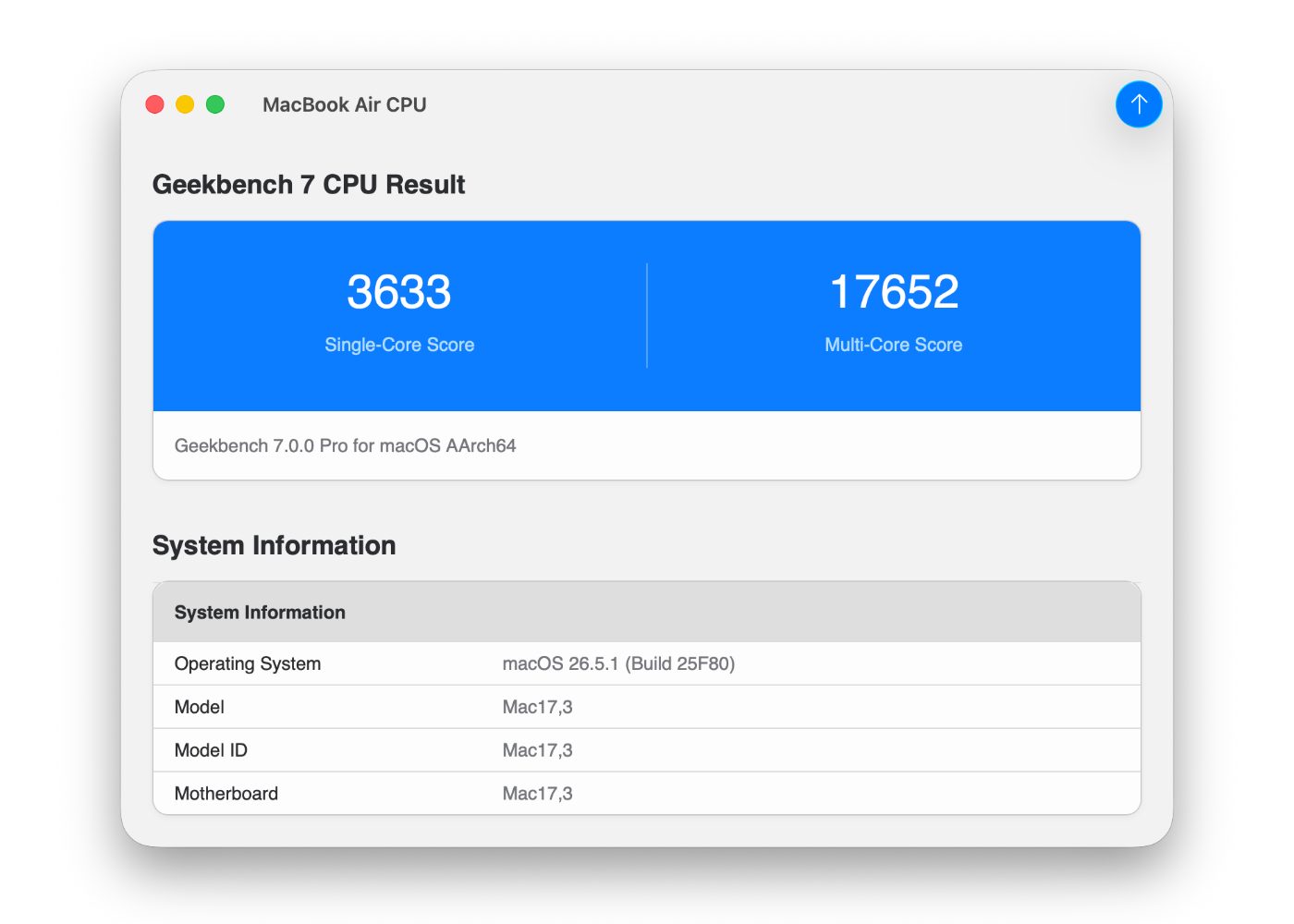
Geekbench 7 is now available as the latest major update to Primate Labs’ widely used cross-platform benchmarking tool, bringing several notable changes to the platform, including new and improved workloads to assess the performance of your device.
This major update comes about three and a half years after the release of Geekbench 6, which also included new and improved workloads, modern data sets, and more.
The update adds new media workloads to evaluate and assess the capability of the CPU to run tasks like audio/video encoding, decoding, and processing. These are the new workloads, according to Primate Labs:
- ” Encode screen-sharing video with the AV1 codec, modeling the screen-sharing features in video conferencing apps.
- Compress music and spoken-word audio with the Opus codec, modeling voice memo and podcast apps.
- Decode video and audio while generating live captions with the Whisper speech recognition model, modeling video playback with automatic subtitles enabled.
Alongside the new media workloads, Geekbench 7 adds a Game Physics workload built on the Jolt Physics engine used in popular video games, expands the Photo Editor workload with a richer set of real-world edits, and updates the Photo Library workload to support importing and processing modern image formats such as JPEG XL and DNG.”
The Multi-Core benchmark has also been updated to evaluate the performance of your device based on real application behavior in everyday tasks. Now, for a task to be included in multi-threaded mode, it needs to be multi-threaded in real applications.
The GPU Benchmark also includes new workloads for Machine Learning, which are capable of performing the following, according to Primate Labs:
- “Track faces and apply real-time filter effects to video, modeling the face filters in social media apps.
- Upscale images with machine learning, modeling super resolution features in content creation apps.
- Blur backgrounds in video conferencing streams, modeling virtual background features in video conferencing apps.
Geekbench 7 also introduces new GPU image editing and synthesis workloads, including RAW image processing, LUT-based video color grading, path tracing, and fluid simulation.
And by popular demand, CUDA joins OpenCL, Vulkan, and Metal as a supported API in the GPU Benchmark. You can now measure your NVIDIA GPU using the API that powers its most demanding applications.”
Additionally, Geekbench has updated its data sets again to assess performance based on the kind of complex files being used in today’s time. These include:
- “More (and more varied) archives in the File Compression workload, spanning source code, object code, and text documents.
- More (and more varied) documents in the PDF Viewer workload, from park maps to technical documents to academic papers.
- More assets and different image formats throughout the developer and image processing workloads.”
Geekbench 7 has already launched on several platforms including iOS, macOS, Android, Windows, and Linux for free, while Geekbench 7 Pro is available for a discounted price of $79 until August 6th, after which the regular pricing of $99 will apply.
Test the capability of your device on Geekbench 7 and let us know your scores in the comments or tweet/post to us at @appleosophy! Be sure to download the Appleosophy App from the App Store or visit our website to stay updated with the latest Apple News!
Comments
Comments will load as you approach this section.