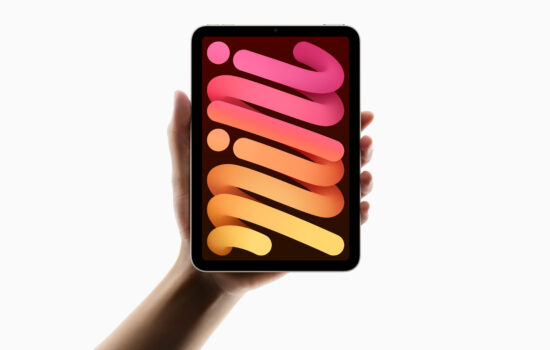
It has been rumored that the next-generation iPad mini will incorporate an OLED display, and Bloomberg even recently reported that this tablet would be among Apple’s next products to adopt this kind of display technology. Come to think of it, it looks like this future iPad mini is going to be a great alternative to an ebook reader, and here’s why.
Now, I know there have been several dedicated ebook readers such as Amazon’s Kindle lineup, and yes, some people do prefer those devices for little to no distractions. But some people just want more utility or versatility. If you look at the current iPad mini, it features an 8.3-inch Liquid Retina display, which uses LED-backlit LCD technology. This size is more ideal to read ebooks on the go, as you can easily hold this thing with just one hand. Now there are two major improvements that are rumored to be coming to the next iPad mini.
First, as previously mentioned, the next iPad mini is expected to feature an OLED display. The current iPad mini’s display maxes out at 500 nits of brightness, and we already know the benefits of having an OLED display with higher brightness levels, richer color accuracy, and improved contrast ratios, especially with brighter whites/deeper blacks. Most people love to read ebooks outside, especially during the sunny days in the summer, but the problem with reading ebooks on something like the iPad is that the screen sometimes does not feel bright enough, especially in a very bright environment. So having a brighter screen would mitigate that issue. It’s unclear how much brighter this OLED display is going to be for the next iPad mini, but I would estimate that it’s going to be 600 nits since Apple is also rumored to be developing a future iMac with an OLED display that will max out at 600 nits.
Now, it’s rumored that the next iPad mini will feature single-stacked OLED panels, unlike the dual-stacked OLED panels on the latest iPad Pro, but if Apple could put in a tandem OLED display on the iPad mini, that would be awesome as two OLEDs stacked together would allow for double the brightness, so it would be even easier to read in bright sunlight. Plus, OLED displays are more energy-efficient, so they would not only sip less battery life, but they would also generate less heat. Thus, under bright daylight, it would be very unlikely that the display on an iPad would dim after some period of time, unlike an iPhone, which obviously has a bigger body, so it would be less thermally constrained, and the iPad’s aluminum enclosure is able to dissipate heat more efficiently.
Secondly, many people love to read ebooks outside whenever it’s nice and warm, especially by the pool. They wouldn’t need to worry about their e-readers getting splashed on because many of those devices are designed to be water-resistant. However, if water got into an iPad through some mishap, chances are you’d need to have it repaired, as unlike iPhones, none of the iPads are water- or splash-resistant. With that in mind, Apple is looking to bring water resistance to the iPad for the first time, and the next iPad mini would aptly need this feature. With that said, this would give Apple the opportunity to redesign the iPad mini. The last major design for the iPad mini happened in September 2021, and that design was based on the 2018 iPad Pro with its flat edges, a display with rounded corners, and the USB-C port. It’s reported that Apple may use a vibration-based speaker to eject water effectively, and I would bet that it would work similarly to how the Apple Watch ejects water after using it underwater or after a swimming workout.
These two major improvements will surely make the iPad mini a much more versatile alternative to any ebook reader. One feature I would like to see on the next iPad mini is faster Thunderbolt speeds. The current iPad mini features a USB-C port that supports up to 10 Gb/s, so having Thunderbolt means faster data speeds, especially when working with Thunderbolt external drives. Another thing that Apple could improve is to have full external display support, just like on the iPad Air and iPad Pro. Currently, if you connect the iPad mini to an external monitor, you’re limited to just screen mirroring. Now it’s possible that the next-generation Apple Silicon on this next iPad mini (rumored to be the A20 Pro) could have an improved display controller, but considering that none of the A-series chips support extended display mode or Thunderbolt, I would not set my expectations high.
The next iPad mini is said to be more expensive than the current iteration, but with these major improvements, I would think it would be worth the price, considering you’re paying more for versatility. Plus, the iPad Air would not get an OLED display until sometime in 2027, so this iPad mini, along with the 12th generation base iPad, may be the top iPad models to get this year, and that’d make two options to choose from: go for the mini if portability matters the most to you, or go for the base iPad if you want the best value. It’s safe to say that this year will be a huge year for the iPad mini.