
AI apps can offer a free trial, a free tier, or credits for particular features, and those arrangements can overlap. A subscription can include a credit allowance, while a trial provides temporary access to paid functions. The labels describe different parts of the experience: how long access lasts, what remains available without payment, and how much work is included.
RevenueCat’s analysis of AI subscription apps, published in August 2026, found freemium access and seven-day trials were more common among its higher-retention group. The study covered 3,519 AI app configurations across iOS and Android. It followed paid subscriptions that began between July 2024 and June 2025 for a year. Those findings concern subscription continuity, rather than app visits, and show associations rather than proof that an access model causes people to stay, but they still offer a very useful starting point.
Incentives are also the focus of an argument that AI retention is a tokenomics problem. That perspective brings the reasons for continued participation into the discussion of AI products. For iPhone and Mac users, ordinary access arrangements offer a concrete starting point: the time to evaluate an app, the functions available without payment, and the allowance for particular actions.
A trial offers time to evaluate
A trial provides a defined evaluation period. Its duration does not necessarily explain how much use is included, or which functions are available. Those are separate product terms, which determine what can be experienced during that period.
For AI software, evaluation involves the result as well as the interface. Producing an output is one part of the experience; its accuracy, relevance, and usefulness require further judgment. The amount of editing needed can also affect whether the feature helps with the work it promises to support. Time allows those judgments to develop across more than one encounter, distinguishing an impressive first result from something consistently useful.
The length of that opportunity remains separate from its outcome. RevenueCat’s findings do not identify a universally effective trial duration. They describe observed patterns across apps, without a controlled test establishing that trial length produced the retention differences.
Trial conversion and later renewal also answer separate questions. Conversion records the move from a trial to a paid subscription; renewal records continuing payment. Neither event alone describes how frequently the app was opened, what was accomplished, or the subscriber’s reasons.
Free access and credits work differently
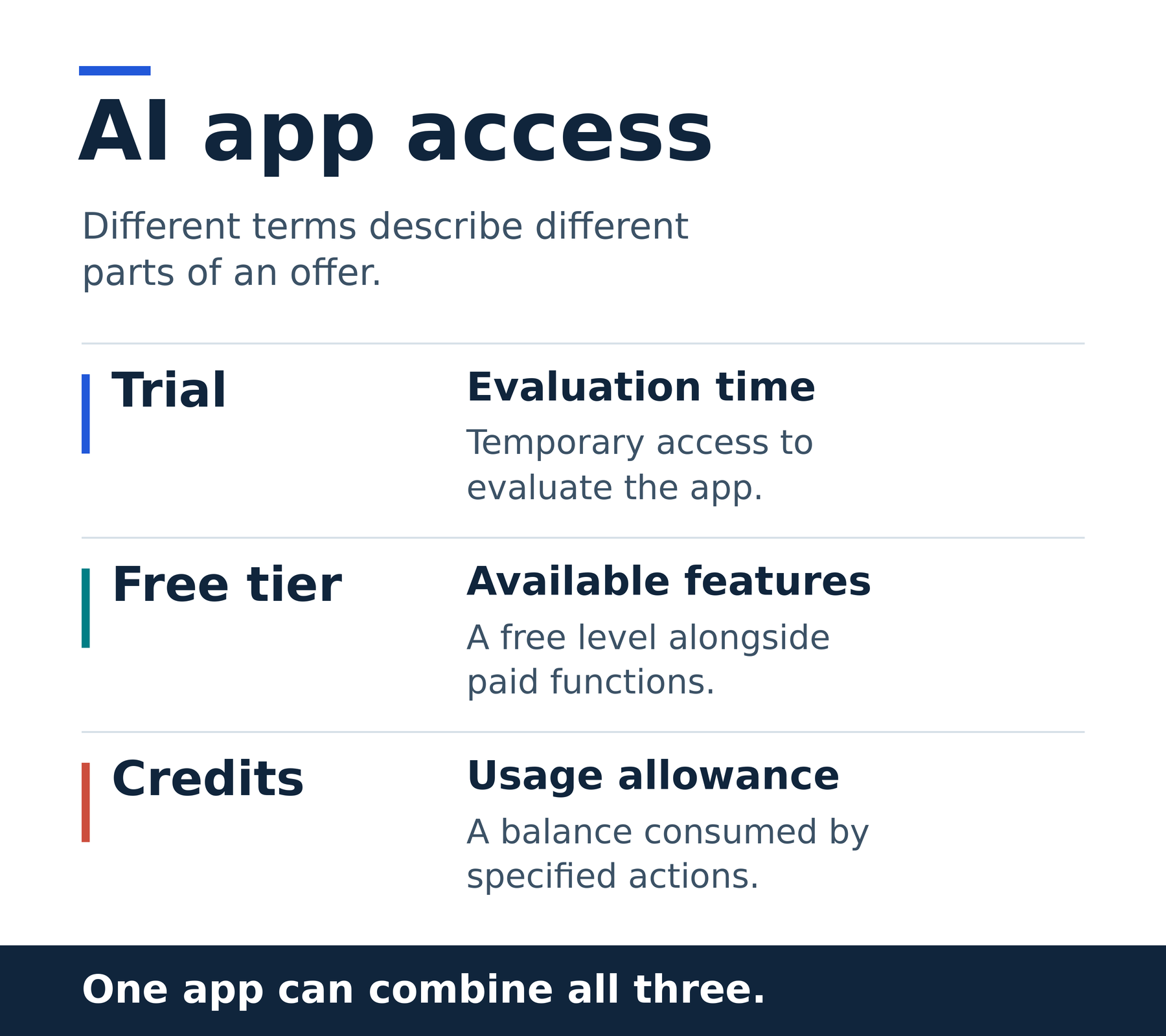
Freemium concerns the functions available without payment alongside a paid offering. Its free level can provide a continuing way to use the product, rather than only an evaluation period. The boundaries still belong to the individual app; “free” does not describe the availability of every function. Credits address another part of access: the allowance for specified actions, including additional generations.
This distinction reflects a practical constraint of AI software. RevenueCat notes that generating an output has a cost, making an unrestricted trial different from simply leaving an interface available. Limiting generations can control usage while still allowing time to evaluate the product. The evaluation period and the amount of work included can be adjusted separately.
A subscription and a credit allowance can exist together. Access to an app does not necessarily include unlimited AI work. Nor is a credit a universal quantity: a balance becomes meaningful through the actions it covers, and the amount deducted for them. The word alone establishes no expiration, rollover, or replenishment terms.
Usage credits and cryptocurrency incentives also describe different arrangements. Permission to generate further output does not establish a transferable token or a participation reward. Metering defines the allowance for work; rewards concern benefits offered for participation.
RevenueCat found that a quarter of its strongest-retaining AI apps also sold consumables alongside subscriptions. Consumables provide an allowance that gets used up, such as extra generation credits. The combined model appears among products with relatively strong subscription continuity, but the study does not establish that the combined model produced the observed retention result.
Access still needs a reason to return
Access creates an opportunity to use an app. The product must still provide something worth doing with that opportunity. A useful result and a useful continuing relationship with software are related, but they are not identical.
Mixpanel’s discussion of evaluating AI through user behavior separates signals such as returning, continuing to use a product, inviting others, and purchasing. Writing from product-management experience, its author considers what happens after an answer is delivered, alongside the answer’s quality.
Those signals help distinguish the offer from what happens after access is granted. Renewals record continuing payment. Return visits describe another encounter with the product. Repeated use of a core function adds information about the activity taking place. Together, these signals distinguish paid access from activity without establishing the quality of every output.
The product’s continuing role can be described through work that accumulates, including projects and history, or through an activity it supports repeatedly. These are ways of organizing usefulness over time, not retention results established by a credit balance.
An access offer is therefore one part of the relationship with an AI app. It makes evaluation or further use possible and defines the terms of that opportunity. The reason to take it up comes from the work the product supports. Continued use remains a separate question from how access is initially supplied.


0 comments
No comments yet. Start a thoughtful conversation.