
Apple AI is changing the face of artificial intelligence on consumer devices. Most cloud AI is operated on massive remote servers. However, Apple is going in its own direction with Apple AI. Instead of trying to catch up to Microsoft or Amazon when it comes to cloud AI, Apple AI focuses on on-device intelligence, privacy, and user data protection.
This difference shows Apple’s consistent belief in what users actually need from AI. To understand Apple’s strategy, we have to look past marketing. In simple terms, modern AI has tradeoffs, and Apple AI accepts them to protect the user.
How Most Modern AI Systems Are Built
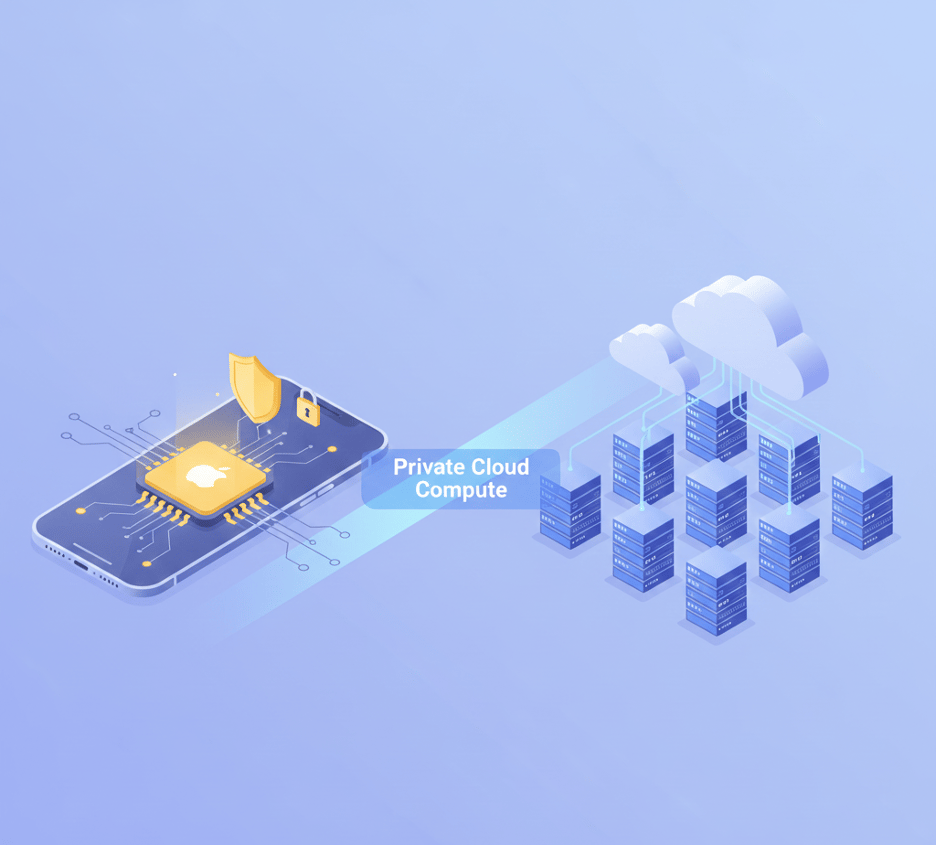
Most AI tools today are based on large AI models hosted in centralized data centers in the cloud. User requests are sent off-device, processed remotely, and then returned with results. This setup allows rapid updates, massive scale, and access to specialized hardware far beyond what phones or laptops can achieve.
This is why cloud infrastructure became the default foundation for tools from Microsoft, Amazon, OpenAI, and Google. Apple AI knows these advantages but only utilizes cloud processing when needed.
Most of these cloud systems rely on generative AI models trained on massive datasets, which helps explain why scale and centralized infrastructure became the default approach. For broader context on how generative AI is evolving, see this BitFern overview of current trends.
Apple AI’s On-Device Intelligence Philosophy
Where others are focused on scale, Apple AI is more focused on local processing. Features such as text prediction, image recognition, and voice processing increasingly run on iPhone, iPad, and Macs with the help of Apple Silicon. This reduces latency, enables offline use, and keeps sensitive data on the device.
Apple’s tight hardware and software integration makes this possible. Custom neural engines and unified memory let Apple effectively optimize AI workloads. Cloud processing still has relevance. However, Apple AI does not treat it as the default choice, but as a backup option.
Privacy as a Product Constraint
Apple’s greatest differentiation is privacy. Apple AI has a purpose for limiting data collection. As a result, it cannot use as much user data as cloud-first systems. While this can make Apple AI feel less flexible, it:
- Protects personal data
- Builds trust
- Avoids unnecessary tracking
Rather than developing a universal assistant, Apple creates intelligence that silently makes life better every day without surveillance.
Performance and Capability Tradeoffs of Apple AI
Apple is not trying to win the AI race in the same way as cloud-first companies. Instead, it aims to be the most trusted AI platform. This distinction shapes everything from model design to user experience.
Cloud AI systems excel at complex reasoning, long-context analysis, and multimodal tasks that require large parameter counts. Apple’s approach is inevitably lagging when it comes to these areas. Some users anticipate that Apple AI is able to compete with cloud assistants. However, cloud systems are still able to manage larger workloads and may appear stronger at first.
Apple AI may not always have the raw power of cloud solutions, but it values reliability more than maximum capability. For tasks like organizing photos, summarizing notifications, or accessibility features, trust matters more than pushing limits.
The challenge for the company is balancing expectations affected by cloud AI hype and a more restrained and device-centric reality.
Why This Strategy Matters for Users and Businesses
Apple’s AI decisions don’t stop with individuals. Developers have to make apps that fit within Apple’s privacy and performance constraints. Enterprises implementing Apple devices need to change expectations regarding automation and analytics. Smaller teams, in particular, have different points of consideration when it comes to responsible adoption of AI.
As AI tools are becoming ever more integrated into business processes, questions relating to data ownership, compliance, and cost become increasingly difficult to overlook. Cloud AI can be powerful; however, it creates dependency that not every company wants to accept.
Looking at broader small business trends helps illustrate why Apple AI’s approach resonates with certain segments. Many small businesses value predictability, data control, and cost stability over state-of-the-art business experimentation. On-device intelligence lowers all dependence on external services and recurring usage fees; it may come at the expense of higher functionality.
This balance makes Apple AI seem conservative to some users. In contrast, others view it to be a practical and predictable strategy.
The Long-Term Bet Behind Apple AI
Apple is not trying to win the AI race like cloud-first companies. Instead, it strives to become the most trusted AI platform. This distinction shapes everything from model design to user experience.
In the long term, Apple is betting that users are becoming more suspicious of where their data is going and how AI systems engage with their personal information. If that changes completely, on-device intelligence might instead appear less like a compromise and more like a competitive advantage.
As hardware advances and Apple Silicon improves, this gap between the local and cloud processing will close – and Apple AI is poised for long-term advantage. The early Apple investment in device-based AI means that it is well-positioned to capitalize on that shift, without having to rework its entire stack.
A Different Definition of Success
Apple’s AI strategy challenges the assumption that bigger models and more data always lead to better products. Instead, it conceptualizes intelligence as something that should make devices smarter in a way that respects people’s boundaries and fades into the background when it is not needed.
This approach will not satisfy everyone. Power users and AI enthusiasts may continue to prefer cloud-based tools for complex tasks. But for millions of users who value reliability, privacy, and seamless integration, Apple AI’s path makes sense.
Rather than chasing the loudest AI narrative, Apple is defining its own version of intelligence. Whether that choice proves visionary or limiting will depend on how user expectations evolve in the years ahead.
Comments
Comments will load as you approach this section.