
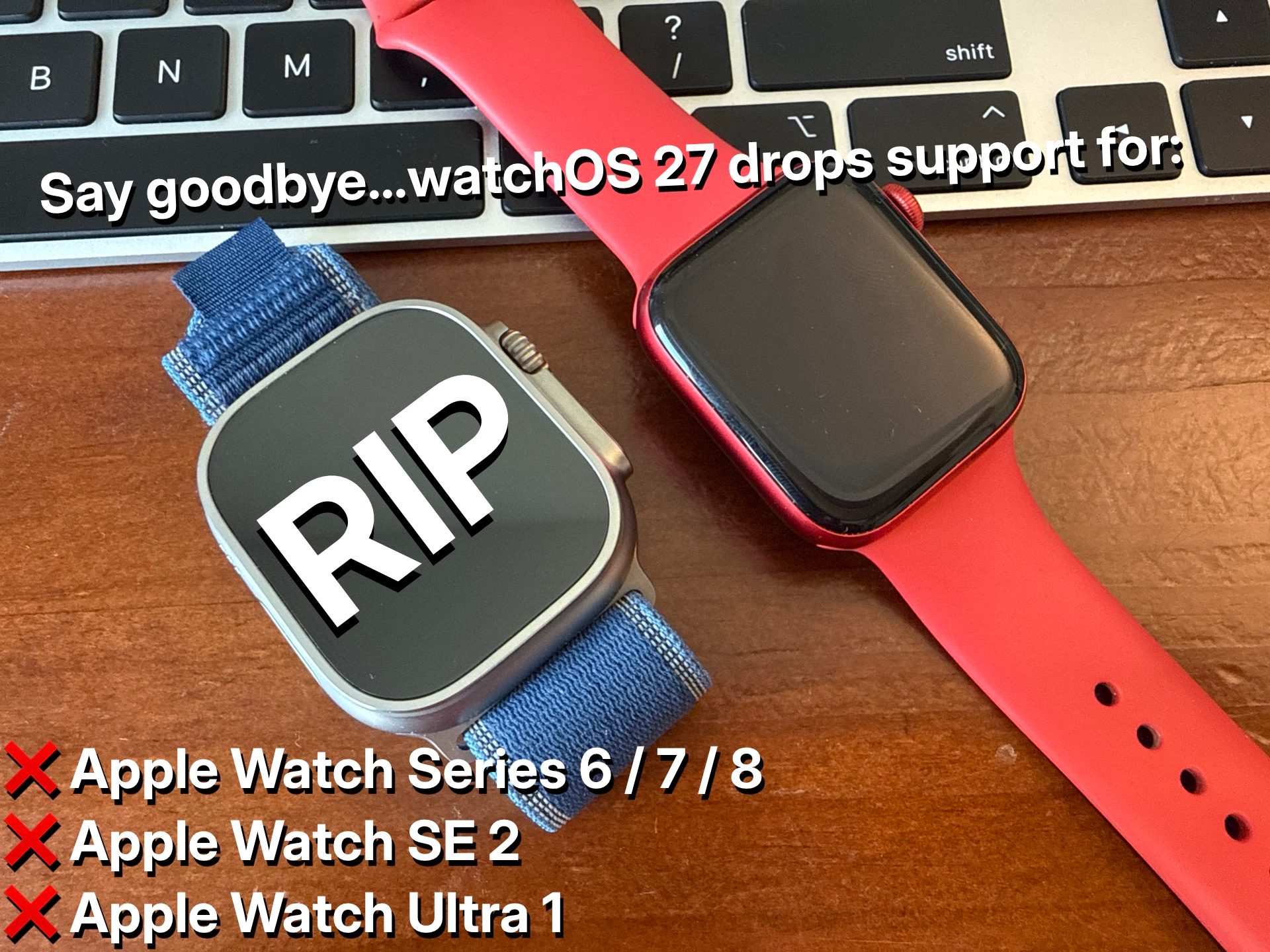
Last week, Apple introduced watchOS 27, and although it didn’t get that much stage time, the biggest feature showcased was clearly Siri AI. However, the biggest shocker was that the next major release of Apple’s smartwatch operating system will drop support for not one, not two, but five Apple Watch models. This has been the largest number of Apple Watch models ever to be dropped for a major release. To bring you up to speed, watchOS 27 will support the following models:
- Apple Watch Series 9, Series 10, and Series 11
- Apple Watch SE 3
- Apple Watch Ultra 2 and Ultra 3.
Side note: the Apple Watch Series 9 was previously omitted from this list, but it turned out it was a mistake on Apple’s end, and Apple has corrected that on its website. (I guess the web developer got confused with the older design of the Series 9, perhaps?)
Anyways, it has become very apparent that owners of older Apple Watch models are not happy with this list, and I’ve been seeing dozens of rants on X, YouTube, etc. The question is: why did Apple drop that many Apple Watch models at once? Before you grab your pitchforks, there is a simple explanation for all of this, but to understand the reason, we have to go back in time.
History
In September 2020, Apple introduced the Apple Watch Series 6, which featured a newer and faster dual-core processor that was based on the A13 Bionic chip in the iPhone 11. The following year, in September 2021, Apple introduced the Apple Watch Series 7, which featured a newer system-in-package (SiP) S7, but carried the same processor as its predecessor. Keep in mind that the system-in-package and the processor are not the same thing, but they are related to each other. The SiP houses all the components and sensors to power the Apple Watch, including the processor, accelerator, gyroscope, compass, and so on. So the processor has been part of the SiP.
Going back to the topic, in September 2022, Apple introduced not one, but three Apple Watch models: the Apple Watch Series 8, the SE 2, and the original Apple Watch Ultra. Those three devices had the newer S8 SiP, but they featured the same dual-core processor as far back as the Series 6. It wasn’t until September 2023 that Apple upgraded to a newer dual-core processor, starting with the Apple Watch Series 9 and the Ultra 2. So for three years, Apple used the same processor. The newer processor that was introduced on the Series 9 had a dual-core architecture that was based on the A16 chip, which, along with the new 4-core Neural Engine, allowed for not only faster performance but also enabled on-device Siri for the first time on an Apple Watch. Furthermore, subsequent models, including the Series 10 in September 2024 and the Series 11 / SE 3 / Ultra 3 in September 2025, all carried that same dual-core processor to this day. Therefore, the modern architecture with the built-in Neural Engine necessitated the requirements to run the upcoming Siri AI on watchOS 27. Even Cait Dooley, Apple Watch and Health product marketing manager, explained the stricter cutoff in an interview with TechRadar:
“With every software release across every single one of our platforms, we always want to ensure that you have the best experience, so we make power and performance a priority. The great new features in watchOS, including the capabilities of Siri AI and the new tap gesture, work best with the processing power that is in Apple Watch Series 9 and later, Ultra 2 and later, and SE 3.”
David Clark, senior director of watchOS software engineering, further added that Apple wanted to optimize the Siri AI experience, and the more modern Apple Watch models are capable enough to support this upcoming feature:
“We really wanted to make sure the Siri experience is a singular and consistent experience, whether I decide to ask Siri on my wrist a question, or whether I have my phone in my hand and I decide to interact with Siri there. We really wanted to feel like it’s one Siri, that has access to your data and is able to personalize it in a consistent way.”
It seems to me that the Apple Watch has been on a three-year update cycle in terms of raw CPU and design:
- Series 6 (2020) introduced a newer dual-core processor that carried on to the Series 7 (2021) and Series 8 (2022). With Series 9 (2023), Apple upgraded to a faster dual-core processor.
- Series 7 (2021) featured a newer design that carried onto the Series 8 (2022) and Series 9 (2023) before Apple redesigned the Apple Watch Series 10 (2024) with an even thinner design.
Now why are some customers frustrated?
Now I can see how customers could get really upset at Apple, particularly those who own either the original Apple Watch Ultra or the SE 2. As mentioned before, because the original Apple Watch Ultra was introduced in 2022, that model will arguably have just four years of software support in terms of major releases (compared to six with the Apple Watch Series 6). As this may imply, the Apple Watch Ultra was introduced relatively late in the Apple Watch CPU’s upgrade cycle.
If we take a look at the Apple Watch SE 2, it would be a different story because the SE model doesn’t get updated as frequently as the higher-end Series and Ultra models. When Apple updated the Apple Watch SE with a third generation back in September 2025, it brought a more modern processor that’s also found in the latest Series 11 and Ultra 3 models. So customers who just bought the Apple Watch Series 2 right before then would certainly feel they would have limited support for software releases. It’s no wonder that owners of the Ultra 1 or the SE 2 feel ripped off by Apple.
You would have to face the harsh reality that older Apple Watch models won’t receive any major software updates with new features. Otherwise, those features wouldn’t work efficiently on those models, which could lead to severe performance hits and potentially worse battery life. At that point, Apple would face significant backlash for delivering a less-than-optimal experience on older Apple Watch models. As you may know, the batteries on Apple Watch models are relatively small in terms of capacity, so the battery may age more quickly (and thus have shorter battery life down the road) than something like a smartphone or a laptop. Now you may ask, “Why can’t Apple update the processor yearly as it does with its iPhones?” The bottom line is related to R&D costs: investing in development for newer dual-core processors leads to more R&D costs overall, so by not updating the dual-core processor as frequently as the iPhone’s SoC, it would have Apple expenses overall. Thankfully, Apple has confirmed that older watchOS versions will continue to receive security or maintenance updates going forward, as with older iOS, iPadOS, and macOS releases, for as long as around three additional years. If I were still stuck on an older Apple Watch, I would take the extended support of security updates (and optimized performance) even if it means I would have to miss out on newer features required by modern hardware.
After understanding the dilemma that Apple has been in and the backlash the company may face, I still see why customers could still be ticked off by Apple’s decision, and Apple may be in another no-win situation, but I do think it’s the right move.
What to do now?
I would still expect the Apple Watch Series 12 (and perhaps the Ultra 4 or SE 4 if Apple were to also announce those) to get an even faster CPU, but because the current CPU on the Apple Watch is relatively modern, I’d expect something like the Apple Watch Ultra 2 would get at least watchOS 28 the following year (and potentially more years of software support). But if you’re still not happy with your purchasing decision back then, here’s my upgrading/buying advice: I’d say to get the first Apple Watch model that introduced a newer processor (i.e., the first model in the CPU’s upgrade cycle); that way, you’d get the most number of years of software support. If you prefer newer designs, you can’t go wrong waiting another year (i.e., the second model in the CPU’s upgrade cycle); just make sure you don’t wait to upgrade towards the end of an upgrade cycle.
Thankfully, there’s no better time to upgrade to a newer Apple Watch as Apple has started offering educational discounts for Apple Watch, and I’m sure Apple’s annual Back-to-School program in the U.S. will have some promotion when you purchase an Apple Watch from them, so keep an eye out for that.
Do you agree with my take on this situation, or are you still just ticked off, frustrated, or disappointed? I’m sure not everyone feels that way. Still, let us know in the comments about this dilemma below, and be sure to bookmark this page and follow us on our social accounts for more news and deals related to Apple!
Comments
Comments will load as you approach this section.